Grassroots organizing may bring ranked-choice voting decision to Hopkins ballots this fall
Natalie Cierzan
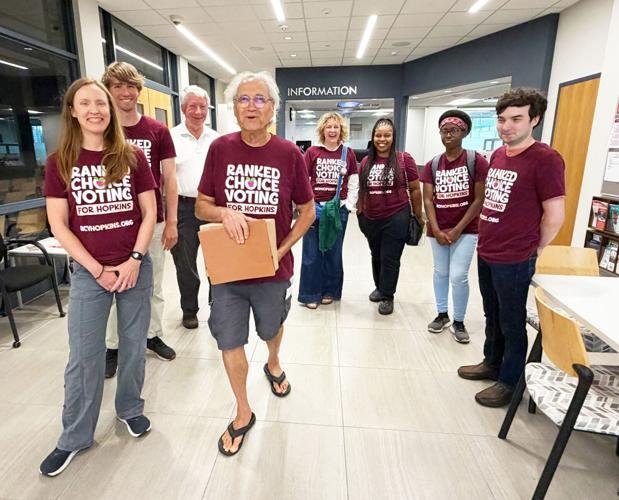
Petitioners deliver nearly 1,000 signatures to City Hall
Nearly 1,000 signatures from Hopkins residents were delivered June 18 to Hopkins City Hall with one mission: Getting a question about whether or not to shift to ranked-choice voting on city ballots in the fall.
The shift, which would require an amendment to the Hopkins City Charter, would move away from the city's current way of operating in a single-round general election, the norm for the majority of cities in the United States. A ranked-choice voting system would instead have voters rank chosen candidates in order of preference, with votes counted in rounds until a candidate earns majority support and is declared the winner.
The grassroots efforts came from the resident group Ranked Choice Voting for Hopkins, which began its work in March. An April kick-off night featured local legislators Larry Kraft and Cheryl Youakim, along with an interested body of more than 100 attendees.
On June 18, local residents who kick-started the initiative as well as additional support from current and former local government officials, brought the signatures forward.
Now, the group awaits signature verification from City Hall. With a surplus of signatures, resident Gary DeVaan, the lead organizer for Ranked Choice Voting for Hopkins, said the number they have will most likely be enough even if some of the signatures may belong to people who do not live in Hopkins. Once the group went through the signatures themselves, he said he believes some of them may belong to residents of neighboring cities who visited Hopkins events, but he only estimates around 10% of those may be the case.
According to Minnesota Statute, a city's charter commission may propose amendments to a charter and do so following a petition from voters equal in number to 5% of the total votes cast at the last previous state general election in the city. Proposed charter amendments must be submitted at least 17 weeks before the general election.
After signatures are verified, it will be up to the Hopkins Charter Commission and Hopkins City Council to finalize and approve the wording of the question. If voters choose to approve a ranked-choice voting question in the fall, the city could begin implementing it as early as 2028.
According to DeVaan, engagement through door-knocking as well as tabling at festivals and events led to the group amassing nearly 1,000 signatures, more than twice the number the group estimated to need.
Steve Kelley, a former Democratic representative and senator for the Hopkins area in the '90s up to the mid 2000s, was a strong proponent of the measure at the conference.
"At a time when too many people feel frustrated with politics, ranked-choice voting offers a practical, common sense improvement to the way we elect our leaders," he said.
He stated that ranked-choice voting gave voters more choice, reduced concerns about vote splitting and encouraged candidates to engage with more community members.
"Hopkins is a city that values participation, inclusion and innovation and frankly is the best town in the entire world probably," said lead petitioner and Hopkins School Board Member Sara Wilhelm Garbers. "So we should have an election system that reflects all of the best of our values. That's why I signed on to to be a lead petitioner and that's why I'm so excited and honored to help bring this question to Hopkins' voters."
Vice Chair of the Hopkins School Board Brook Ann Roper said her support for ranked-choice voting dated back several years.
"As a school board member, I understand the importance of assuring that every voice in our community is heard and represented, and that's one of the reasons I support rank choice voting," she said.
Roper said school boards often speak about preparing students to be engaged citizens while teaching the value of participation in democracy, and that she felt ranked-choice voting aligned with those values.
One of the younger signatures on the petition belonged to William Kessler, another lead petitioner who felt many in his generation cared deeply about the future.
"Too often we feel disconnected from the political process and like our voices aren't being heard. Local politics affects us all, whether it's housing, parks, transportation, school systems and the general future of our community, and these are all important issues and conversations that we all want to be a part of," he said.
In his view, ranked-choice voting would encourage more candidates to run.
Neighboring cities Minnetonka and St. Louis Park already use a ranked-choice voting system, as well as Bloomington, Minneapolis and St. Paul. Ranked-choice voting is also used in some cities in Illinois, Michigan, New York, California, Oregon and Washington.