
All About Ranked Choice Voting
Residents of Bloomington, Minneapolis, Minnetonka, St. Louis Park, and St. Paul already use Ranked Choice Voting (RCV) for their local elections—and Hopkins could be next!
Each city in Minnesota that has chosen to use RCV has experienced higher voter participation, more diverse candidates, more civil campaigns, and happier voters.
Ranked Choice Voting is a simple but powerful way to vote that allows voters to rank candidates in order of preference and ensures the candidate(s) who win do so with a majority or the highest support possible in a single, decisive and cost-effective election. In ranked-choice elections, voters rank as many or as few candidates as they like from their favorite to least favorite: first choice, second choice, and so on.
Jump to:
Ranking Your Ballot
Filling out your ballot using Ranked Choice Voting is easy: Simply indicate your first choice candidate in the first column, your second choice in the second column, and so on. Remember that the more candidates you rank, the more power your ballot will have.
There is no way to vote strategically using RCV. Voting only for one candidate or the same candidate more than once, will not improve that candidate’s chances of winning.
Best practice is for voters to rank as many candidates as they like and as long as they have a preference between candidates.
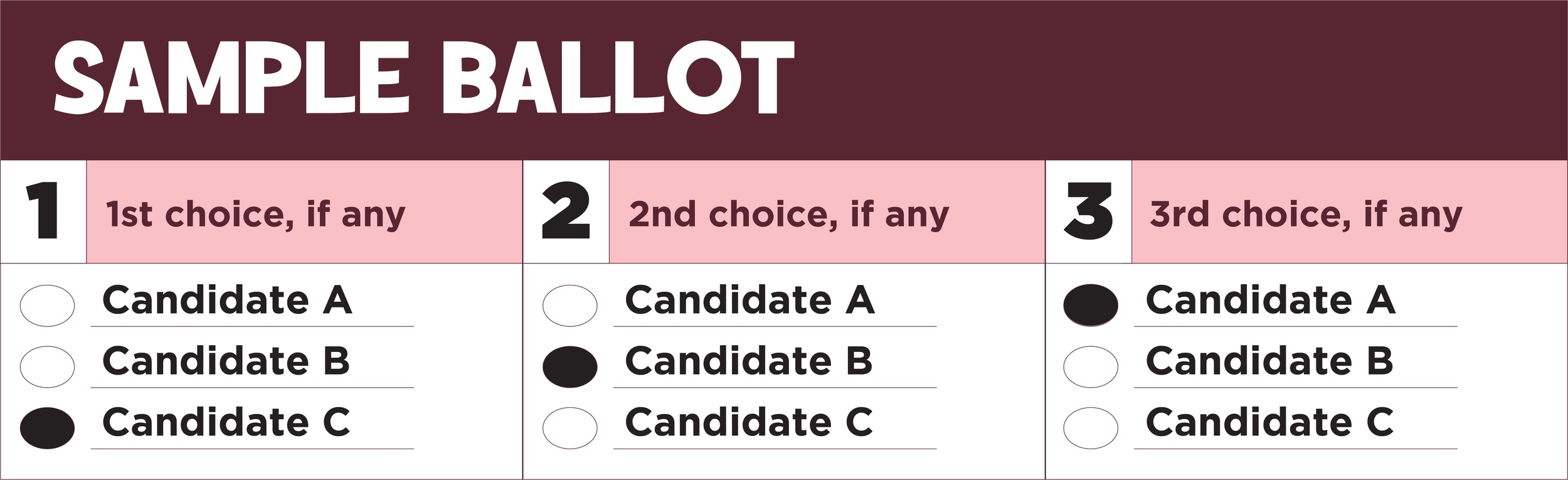
Why Rank Your Ballot? It’s very important to rank as many candidates as you like (up to the maximum allowed on the ballot):
By ranking all your choices, you maximize the power of your vote.
If your favorite or first choice candidate doesn’t have enough votes to win, your vote will continue to count for your second and subsequent choices, and you still have a say in who’s elected.
You can vote your conscience without worrying that you’re wasting your vote.
By ranking all your choices, you maximize the power of your vote.
Voting only for one candidate or the same candidate more than once, will not improve that candidate’s likelihood of winning.
There are no downsides to ranking candidates:
Ranking a second, third, etc. choice will never hurt your favorite candidate.
Your vote counts for your second choice only if your first choice is eliminated. Your vote counts for your third choice only if your first and second choices are eliminated, and so on.
RCV In Single-Seat Elections
Winning a single-seat RCV election requires a candidate to earn support from a majority of voters, or 50% of votes + 1 vote more. If a candidate earns a majority of first-choice votes then that candidate wins, just like in our current system.
However, if no candidate receives majority support, then an instant runoff process takes place. In the runoff, the candidate with the fewest first-choice votes is eliminated, and their votes now count for their second choices. This process continues until one candidate reaches a majority and wins.
Example
Below are the vote totals in a possible election for Hopkins Mayor using RCV. Voters’ first choices are counted. No candidate has a majority, meaning there has to be a second round of counting. Candidate B has the fewest votes and is eliminated.
Ballots for Candidate B count for the voters’ next choices. Candidate C earns a majority and is elected.
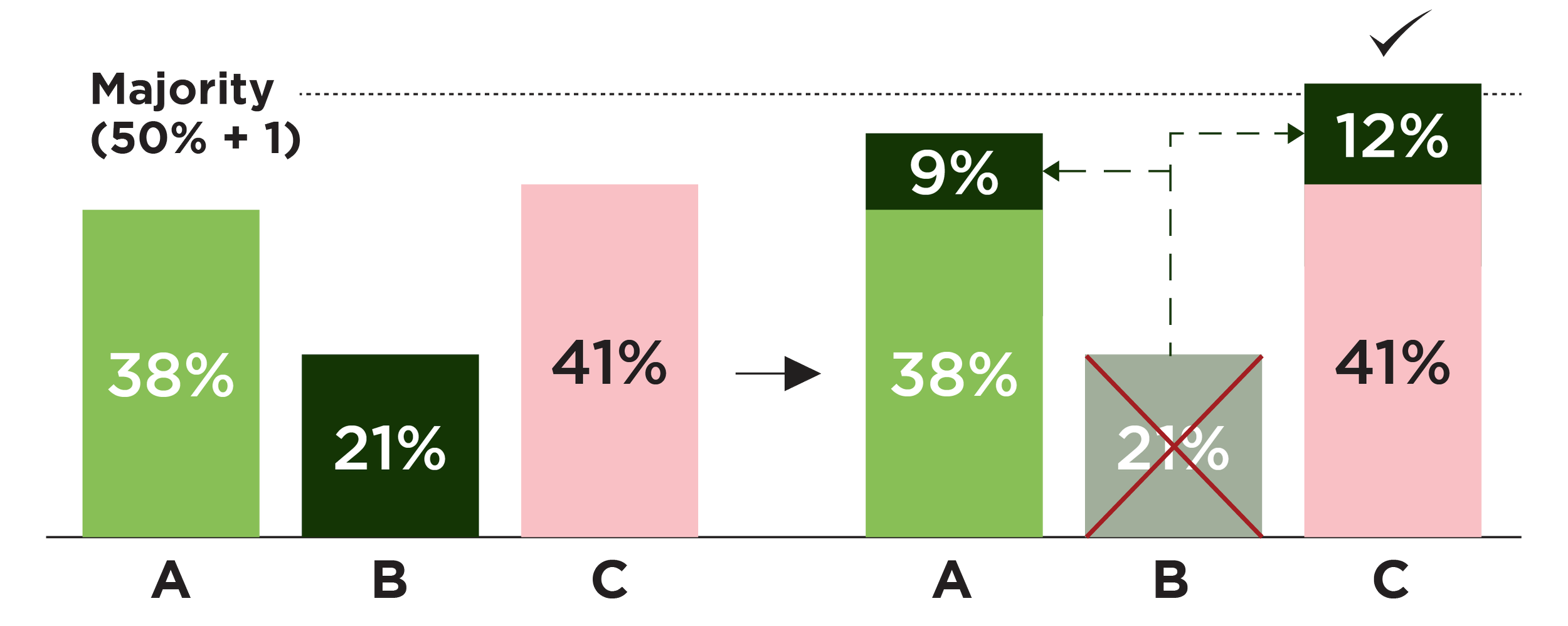
The result of the counting process is a winner has the broadest possible community support.
RCV In Multi-Seat Elections
In a two-seat RCV election, voters rank candidates in order of preference, just like they would in any RCV election. Any candidate who earns enough support (33%) to win a seat is elected, and any extra support they have can transfer to voters’ next choices—so more voters help elect someone they support. The result is that two winners are chosen in a way that better reflects the community and gives more voters a voice in the outcome.
Currently in Hopkins, each voter has two votes to cast in two-winner elections. Each person has two votes the two candidates with the highest totals are the winner. In years when there are a large number of competitors, this has lead to winners who claimed victory with less than a quarter of the vote.
With RCV, more voters get to have their voices heard.
Frequently Asked Questions
-
Ranked Choice Voting is a simple but powerful way to vote that allows voters to rank candidates in order of preference and ensures winners with a majority or the highest support possible in a single, decisive and cost-effective election. In ranked-choice elections, voters rank as many or as few candidates as they like from their favorite to least favorite: first choice, second choice, and so on.
-
No. You can rank as many or as few candidates as you like, up to the limit of choices permitted by the final rules of the election. In most local RCV elections, voters can choose up to three choices. The value of ranking is to allow a voter to continue to express their preferences between candidates even if their first choice is eliminated in the instant runoff process. The more a voter ranks, the more power their ballot has in deciding the outcome of the election.
-
First-round election results are available on election night, and all candidates who meet the winning threshold will be reported. For all other races, the results will be available the following day.
-
No. Voters have the power to rank candidates, but their vote only counts for one candidate in the final round of counting.
As the Minnesota Supreme Court made clear: Every voter gets an equal vote. In each round of counting, your ballot counts as one vote for your highest-ranked candidate still in the running. If your favorite candidate has been eliminated, your choice is limited to one of the remaining candidates—just as in a traditional primary election. But under RCV, your vote automatically counts for your next choice on the ballot without the need to hold a second election.
-
No. An RCV election may require several “instant runoff” rounds of counting to determine which candidate has majority support. During that process, a voter’s ballot counts as one vote for their highest-ranked candidate still in the running. All voters’ ballots count equally at every round of voting.
-
No. Your vote counts for your second choice only if your first choice is eliminated. Your vote counts for your third choice only if your first and second choices are eliminated.
-
Whether using a ranked-choice ballot or a “traditional” ballot, mistakes are handled the same way. If you make a mistake on your RCV ballot that would disqualify your ballot (i.e., voting for more than one candidate in the same column), the tabulator would reject your ballot, and you would have an opportunity to correct it.
-
Yes. In 2009, the Minnesota State Supreme Court unanimously ruled that Ranked Choice Voting is constitutional: “Every voter has the same opportunity to rank candidates when she casts her ballot, and in each round every voter’s vote carries the same value.” Minnesota Voters Alliance v. FairVote Minnesota, June 11, 2009. Federal courts have also ruled that RCV meets all tests under the U.S. Constitution.
-
Minnesota’s experience with RCV has been a resounding success. More than 1 million ranked-choice ballots have been cast in Minnesota since 2009 when Minneapolis first began using the system. According to exit polls in Minnesota cities using RCV, voters consistently and overwhelmingly report that RCV creates more civil campaigns and is easy to use, liked, and preferred over the old voting system. Voter participation is higher in local elections using RCV by fostering more competitive elections with multiple candidates—a key driver of voter turnout.
-
About 50 jurisdictions across the country use Ranked Choice Voting, including the states of Maine and Alaska and five cities in Minnesota: Minneapolis, Saint Paul, St. Louis Park, Minnetonka, and Bloomington. Six states—Alabama, Arkansas, Georgia, Louisiana, Mississippi, and South Carolina—use Ranked Choice Voting for military and overseas voters.
RCV is also used in democracies around the world, including Australia, New Zealand, Malta, the Republic of Ireland, Northern Ireland, Scotland, and in the city of London, England. Elected officials in India, Nepal, and Pakistan use the multi-winner form of RCV to select their national senates. -
In 2004, the League of Women Voters Minnesota conducted an exhaustive, two-year study of voting systems and reached a consensus that endorsed Ranked Choice Voting as an option for local and state elections in Minnesota.
In 2006, FairVote Minnesota, with the support of the League of Women Voters Minneapolis, former Minneapolis Mayor Don Fraser and dozens of volunteers, led a grassroots campaign to adopt RCV in Minneapolis that voters approved by a 2-to-1 margin.
-
RCV is a simple, proven change to the ballot that:
Gives voters greater voice, choice and power
Reduces political division and extremism
Ensures whoever wins has most voter support possible
Fosters more civil campaigns and a more responsive government
Promotes more inclusive, diverse and representative elections
Eliminates the spoiler problem and wasted votes